


Kicker Reform Could Correct Tax Inequity
The Oregonian recently published an opinion piece by Tim Knopp, Republican legislator from Bend, extolling the virtues of Oregon’s kicker tax refund.
The kicker occurs if actual state revenues exceed forecasted revenues by 2 percent or more over the two-year budget cycle. The excess is returned to taxpayers through a credit on their following year’s tax return.
We’ve now learned that this year’s kicker could be a stunning $1.4 billion, with five-figure refunds going to the richest Oregonians while of the rest of us get a few hundred dollars.
Knopp makes the absurd assertion that “taxes belong to taxpayers, not the government.”
Under his tortured logic, taxes are not payment for state services. Rather they are some kind of weird loan.
Think how this would work if businesses operated this way. We buy a product or a service from a business, then closely monitor if the business subsequently had a good year financially. We would then demand a partial refund.
Knopp defends the large percentage of the kicker that goes to wealthy taxpayers. Pay more in, get more back, he argues. Leaving aside that there was no fundamental reason the kicker needed to be structured this way, Knopp’s argument ignores the true picture of Oregonians’ tax burden.
Here is a graph from the Oregon Department of Revenue on effective Oregon income tax rates by gross income.
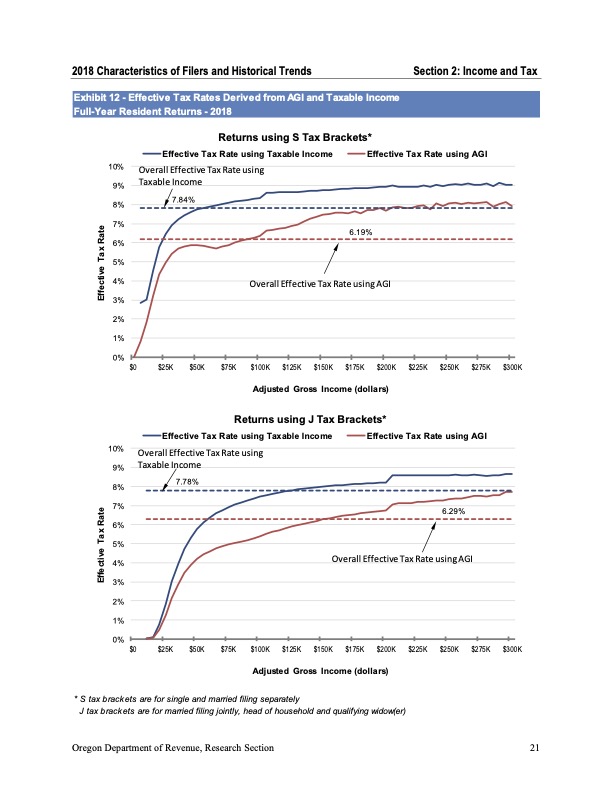
This looks sort of fair. The rich pay the highest rate. Lower income people pay a much lower rate. But there is a big missing piece here: payroll taxes, paid to the federal government by every employee that earns wages. Payroll taxes fall most heavily on low- and middle-income wage earners because the social security portion (6.2 percent) is not collected on earnings over $142,800. So the graph above really looks like this because above $142,800 social security tax paid no longer rises with income.
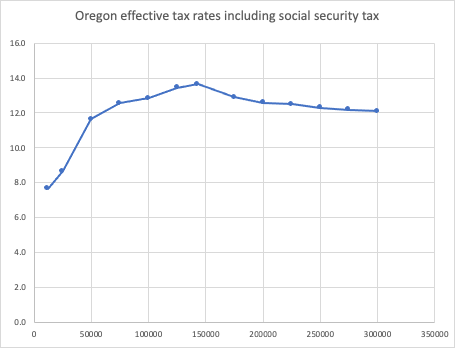
That’s right. Someone making $300,000 per year has a lower effective tax rate than someone making $75,000 per year. Not only that, above $300,000 per year, the graph keeps dropping. Million-dollar earners (not shown above) have a tax rate lower than someone earning $50,000.
Oregon’s income tax is dramatically regressive, lightly touching the richest taxpayers while taxing low- and middle-income people at high relative rates.
Restructuring the kicker’s distribution could help correct this massive tax inequity. But reform would probably require a ballot measure, making any such effort very difficult.
As we ponder this, let us remember that the kicker originated straight out of the Republican playbook, which calls for starving the government “beast”, crimping government spending (except, of course, for their own pet projects), and ensuring the wealthy never pay their fair share. It has achieved these goals well. Millionaires bank big refunds while the rest of us get the crumbs.
[…] I recently wrote about the fundamental inequity in distributing Oregon’s kicker tax refund based on the amount of taxes paid. We all know very wealthy people have big tax bills (usually). This does not necessarily mean they deserve big kicker refunds which only serve to exacerbate the regressiveness of Oregon’s income tax. […]
[…] already knew that Oregon’s tax system is regressive if payroll taxes are included. High state income tax rates are reached at relatively modest […]